


Published: July 14, 2026
by
Marguerite Cotter
Burglaries in Ireland rose 2% in the first quarter of 2026 compared with the same period in 2025, according to newly released data from the Central Statistics Office. A total of 2,161 burglaries were recorded between January and March 2026, up from 2,124 in Q1 2025, a difference of 37 incidents.
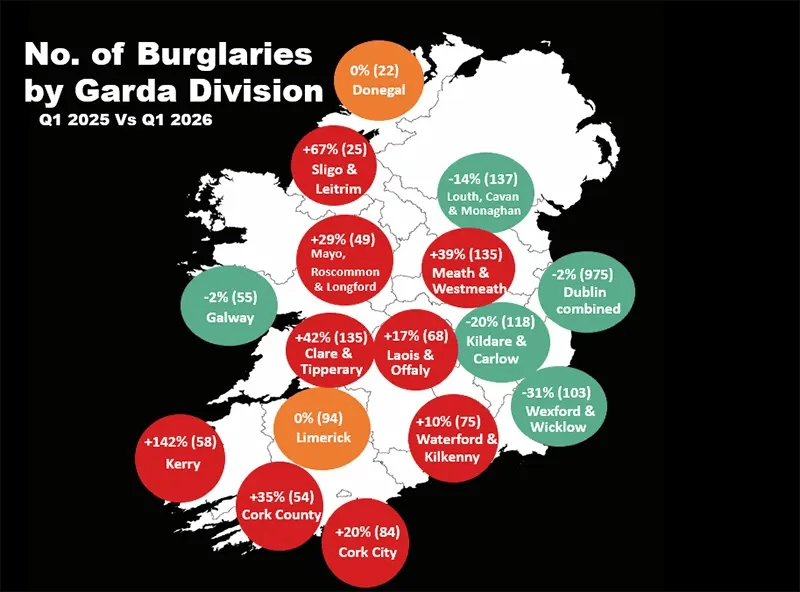
While the national increase is modest, it marks a reversal of the downward trend reported in the full-year 2025 data. More importantly, the picture varies dramatically by region: 11 of Ireland's new restructured 21 Garda divisions recorded increases, 8 saw decreases, and 2 were unchanged.
This article breaks down the Q1 2026 figures nationally and by division and explains what they mean for Irish homeowners. Note that these figures reflect the restructured 21-division Garda model, which replaced the previous 28-division structure.
Quick Facts: Burglary Statistics Ireland 2025
- Total burglaries in Q1 2026: 2,161
- Total burglaries in Q1 2025: 2,124
- Year-on-year change: +2%
- Divisions recording an increase: 11 of 21
- Divisions recording a decrease: 8 of 21
- Divisions unchanged: 2 of 21
- Highest percentage increase: Kerry at +142% (from 24 to 58 incidents)
- Highest percentage decrease: Wexford / Wicklow at −31%
- Source: Central Statistics Office (CSO), Q1 2026 release
National Picture: A 2% Rise
The 2% year-on-year increase in Q1 2026 is a small move in absolute terms, just 37 additional burglaries across the entire country, but it is still far too many for any homeowner to have to endure. On its own, that figure would barely register. But context matters. Throughout 2025, Ireland experienced a 13% annual decline in burglaries, a trend that gave homeowners and policymakers reason for cautious optimism. The Q1 2026 data interrupts that improvement.
Quarterly figures are inherently more volatile than annual totals. A single spike in one division can shift the national number, and seasonal factors such as weather, holidays, daylight hours play a larger role over three months than twelve. For that reason, the national headline is less revealing than the divisional breakdown beneath it. The real story in the Q1 2026 data is not the size of the national rise but the sharp regional divergence it contains.
It is worth emphasising that 2,161 is a first-quarter figure. It should not be compared directly to the 8,469 burglaries recorded across the full year of 2025, as the two cover different timeframes.
Regional Breakdown: Where Burglaries Rose and Where They Fell

Divisions With the Biggest Increases
Five Garda divisions stand out for their year-on-year increases in Q1 2026:
|
Garda Division |
Q1 2025 burglary incidents |
Q1 2026 burglary incidents |
% |
Additional Incidents |
|
Kerry |
24 |
58 |
+142% |
+34 |
|
Sligo / Leitrim |
15 |
25 |
+67% |
+10 |
|
Clare / Tipperary |
95 |
135 |
+42% |
+40 |
|
Meath / Westmeath |
97 |
135 |
+39% |
+38 |
|
Cork County |
40 |
54 |
+35% |
+14 |
Kerry and Sligo / Leitrim post the largest percentage increases, but both rise from very low base counts. A jump from 24 to 58 incidents produces a striking 142% figure, yet the absolute increase of 34 burglaries is smaller than the rises in Clare / Tipperary (+40) and Meath / Westmeath (+38). Those commuter-belt and mid-west divisions represent the most materially significant increases by volume and deserve close attention from homeowners in those areas.
Divisions With the Biggest Decreases
On the other side of the ledger, several divisions recorded substantial improvements:
|
Garda Division |
Q1 2025 burglary incidents |
Q1 2026 burglary incidents |
% |
Fewer |
|
Wexford / Wicklow |
149 |
103 |
−31% |
−46 |
|
Dublin South (DMR South) |
157 |
112 |
−29% |
−45 |
|
Kildare / Carlow |
148 |
118 |
−20% |
−30 |
|
Louth / Cavan / Monaghan |
160 |
137 |
−14% |
−23 |
|
Dublin East (DMR East) |
161 |
145 |
−10% |
−16 |
Wexford / Wicklow's 31% drop is particularly notable because those areas were among the divisions recording increases in the 2025 annual data. The reversal suggests that targeted policing or local factors may have an effect. Dublin South (DMR South) also saw a sharp decline of 45 fewer incidents.
Across the six Dublin Metropolitan Region divisions combined, burglaries fell in Q1 2026, with Dublin South and Dublin East leading the improvement. However, the picture within Dublin was uneven: Dublin North Central (DMR North Central) rose 19%, from 121 to 144 incidents, while Dublin North (DMR North) edged up 2%.

Rural Ireland: Where the Increases Are Concentrated
A clear pattern emerges from the divisional data: the sharpest Q1 2026 increases are concentrated in rural, western, and mid-west divisions. Kerry recorded the single largest rise of any division. Sligo / Leitrim, Clare / Tipperary, Mayo / Roscommon / Longford (+29%, from 38 to 49 incidents), and Cork County all saw meaningful increases, while several Dublin and southeast divisions fell.
Homes outside urban centres typically face longer Garda response times, fewer passing witnesses, and outbuildings or farm structures that can be easier to target. These are exactly the conditions where a professional monitored alarm with an average response time of 15 seconds adds the most value.
For readers on farms or rural properties, a dedicated farm security guide covers the specific risks and solutions relevant to agricultural settings.
What the CSO Stats Mean for Irish Homeowners
The Q1 2026 data carries a few clear takeaways for anyone thinking about the security of their home.
First, a modest national average can mask dramatic local variation. While the country as a whole saw a 2% rise, individual divisions moved by as much as 142% upward or 31% downward. Where you live matters far more than the national headline.
Second, quarterly data is inherently noisier than annual figures, and a single quarter does not confirm a new trend. But the reversal of 2025's downward trajectory is worth noting, particularly for homeowners in divisions where rates climbed. Waiting for the trend to worsen before acting is a gamble.
Third, the fundamentals of home protection remain the same regardless of whether local rates are rising or falling. A monitored burglar alarm remains the most effective deterrent available to Irish homeowners. Previous research consistently identifies the window between 5pm and 11pm as the highest-risk period for residential break-ins a time when many homes are empty but not yet secured for the night.
The data reinforces a simple principle: burglary risk is not evenly distributed, and neither should your approach to security be. Homeowners in divisions recording increases have particular reason to review their protection, but every home benefits from a system that responds in seconds, not minutes.
Full Divisional Table: Q1 2025 vs Q1 2026
|
Garda Division |
Q1 2025 burglary incidents |
Q1 2026 burglary incidents |
Change |
Direction |
|
Louth / Cavan / Monaghan |
160 |
137 |
−14% |
Decrease |
|
Donegal |
22 |
22 |
0% |
Flat |
|
Galway |
56 |
55 |
−2% |
Decrease |
|
Mayo / Roscommon / Longford |
38 |
49 |
+29% |
Increase |
|
Sligo / Leitrim |
15 |
25 |
+67% |
Increase |
|
Cork City |
70 |
84 |
+20% |
Increase |
|
Cork County |
40 |
54 |
+35% |
Increase |
|
Kerry |
24 |
58 |
+142% |
Increase |
|
Limerick |
94 |
94 |
0% |
Flat |
|
Clare / Tipperary |
95 |
135 |
+42% |
Increase |
|
Kildare / Carlow |
148 |
118 |
−20% |
Decrease |
|
Waterford / Kilkenny |
68 |
75 |
+10% |
Increase |
|
Laois / Offaly |
58 |
68 |
+17% |
Increase |
|
Meath / Westmeath |
97 |
135 |
+39% |
Increase |
|
Wexford / Wicklow |
149 |
103 |
−31% |
Decrease |
|
DMR South Central |
164 |
160 |
−2% |
Decrease |
|
DMR North Central |
121 |
144 |
+19% |
Increase |
|
DMR North |
186 |
189 |
+2% |
Increase |
|
DMR South |
157 |
112 |
−29% |
Decrease |
|
DMR East |
161 |
145 |
−10% |
Decrease |
|
DMR West |
201 |
199 |
−1% |
Decrease |
|
National Total |
2,124 |
2,161 |
+2% |
Increase |
Frequently Asked Questions
How many burglaries were there in Ireland in early 2026?
There were 2,161 burglaries recorded in Ireland in the first quarter of 2026, a 2% increase on the 2,124 recorded in the same period of 2025, according to the CSO.
Are burglaries going up or down in Ireland in 2026?
Burglaries rose 2% nationally in the first quarter of 2026 compared with the same quarter in 2025. Of 21 Garda divisions, 11 recorded an increase, 8 recorded a decrease, and 2 were unchanged.
Which areas of Ireland saw the biggest rise in burglaries in early 2026?
The Kerry, Sligo / Leitrim, and Clare / Tipperary Garda divisions recorded the largest year-on-year increases in the first quarter of 2026, though Kerry and Sligo / Leitrim rose from low base numbers.
Which Garda divisions saw the biggest drop in burglaries in early 2026?
Wexford / Wicklow recorded the largest decrease at 31%, followed by Dublin South (DMR South) at 29% and Kildare / Carlow at 20%.
What is the best protection against burglary in Ireland?
A professionally monitored home alarm is consistently the most effective deterrent. PhoneWatch monitors over 120,000 Irish homes 24/7 with an average alarm response time of 15 seconds.