


Published: August 10, 2026
by
Marguerite Cotter
Running a short-term let in Ireland means your property spends days sitting empty between bookings, then fills with guests you have never met, and through it all you are likely managing everything from a distance. With well over 20,000 entire-property short-term lets listed in Ireland at any given time, and roughly two-thirds of all Irish Airbnb listings being entire properties concentrated along the west coast and in inner-city Dublin and Galway (ESRI, April 2025), this is a challenge shared by thousands of hosts.
This guide covers how to protect your let without compromising guest comfort, what the rules actually say about cameras and privacy, and why the difference between an app alert and a professionally monitored response matters more than most hosts realise.
Quick Facts: How do I secure an Airbnb or short-term let in Ireland?
Secure a short-term let with a professionally monitored alarm you arm and disarm remotely by app between guests, keep any cameras outdoors and disclosed in line with Airbnb's rules and GDPR, and rely on a 24/7 Alarm Receiving Centre for verified response rather than app alerts alone.
- Airbnb has banned indoor cameras globally since April 2024; outdoor cameras must be disclosed and must not cover indoor spaces.
- App-managed arming lets a remote host arm after checkout and disarm for cleaners without sharing a fixed code.
- Professional monitoring means a trained team responds to an alarm, not just a phone notification the host might miss.
- PhoneWatch answers alarm activations in an average of 15 seconds, 24 hours a day.
- Ireland's short-term-let register opens in December 2026; hosts must register and display a registration number.
Why a short-term let is a different security problem
A short-term let does not behave like a typical home. It varies between two distinct states of vulnerability. During void periods, the property sits completely empty, sometimes for days at a time, with no one to notice if something goes wrong. Then it fills with guests the host has never met in person, people who have been given access codes or keys and who may share them freely. Add cleaners and maintenance workers into the mix, each needing their own way in, and the result is a property where access is fluid and oversight is thin.
The host, meanwhile, is usually somewhere else entirely. Most Irish short-term lets are entire properties, not spare rooms in an owner-occupied home. That means the host is protecting a whole house or apartment they do not live in, often from hours away. The assumptions that work for a family home, being there to set the alarm, knowing who has a key, hearing the smoke detector, simply do not hold. A let needs security designed around absence, not presence.
The balancing act: protection without spoiling the stay
Every host knows the tension. You want the property protected, but you cannot make a guest feel they are under surveillance or locked out of a system they do not understand. A guest who triggers an alarm they were not told about will not just complain to you; they will say it in a review, and that review will cost you bookings.
The principle that makes this work is simple: good security should be managed by the host and invisible to the guest. It protects the property and the gaps between stays without turning the guest experience into something uncomfortable. Intrusion sensors, not cameras, handle the interior. Access is controlled remotely by the host, not delegated to the guest. And the system works quietly in the background, only making itself known when it genuinely needs to. Everything that follows in this guide builds on that idea.
App alerts vs a monitored response
A self-monitored, DIY alarm sends a push notification to your phone when something triggers it. If you are awake, near your phone, and able to act, that might be enough. But if you are asleep at 2 am, driving, or simply away from your phone, that notification sits unread and nothing happens. For a host who is rarely on site, relying on your own alertness is a fragile plan.
A professionally monitored alarm response works differently. When the alarm activates, a trained team at an Alarm Receiving Centre verifies what has happened and responds, coordinating the Gardaí or emergency services where required. PhoneWatch answers activations in an average of 15 seconds, 24 hours a day, 365 days a year, from a Dublin-based Alarm Receiving Centre.
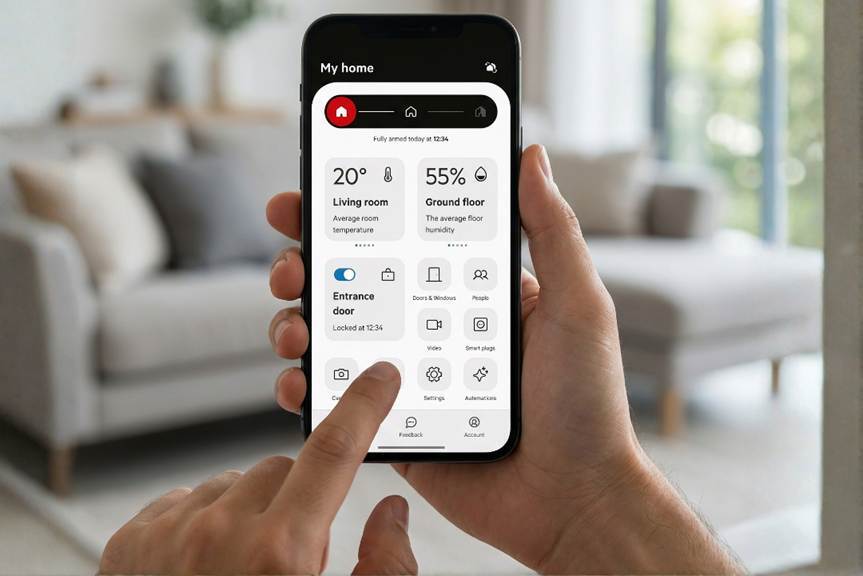
The distinction is not about technology; it is about what happens next. An app alert is information. A monitored response is action. For a property you do not live in, occupied by people you do not know, that difference is the one that matters. The PhoneWatch app not only allows you to arm and disarm the alarm, but also review temperature and humidity, alarm automation, smart home automation and much more.
Managing guest and cleaner access without handing over your system
One of the most practical concerns for any host is access. Guests check in and out, cleaners arrive on changeover day, and a maintenance worker might need to get in at short notice. If everyone shares one fixed alarm code, you have no idea who armed or disarmed the system, or when.
App-managed arming solves this cleanly. Using the PhoneWatch app, you can arm the property remotely the moment a guest checks out and disarm it for your cleaner on changeover day, all without being at the door. You can check door and window status in real time and review arming history, so you know the property was actually secured after the last visit, not just assumed to be.
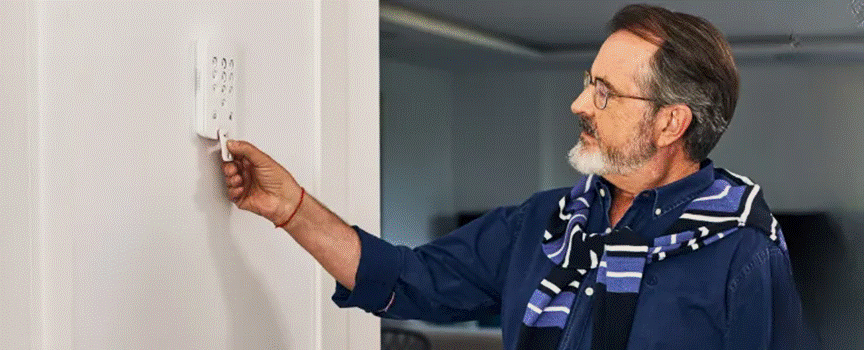
For cleaners and regular contractors, personalised tags can be assigned to them, meaning each person can arm and disarm the alarm without a code. You can see exactly who disarmed the system and when, and you can revoke access instantly if someone stops working for you. This is the kind of operational control that suits a host running a small business, and it is worth noting that PhoneWatch also supports small business alarm systems built around exactly this kind of multi-user, remote-managed setup.
Cameras in a short-term let: what's allowed and where GDPR draws the line
Cameras are the area where hosts most often get it wrong, and where the consequences, both reputational and legal, are most serious.
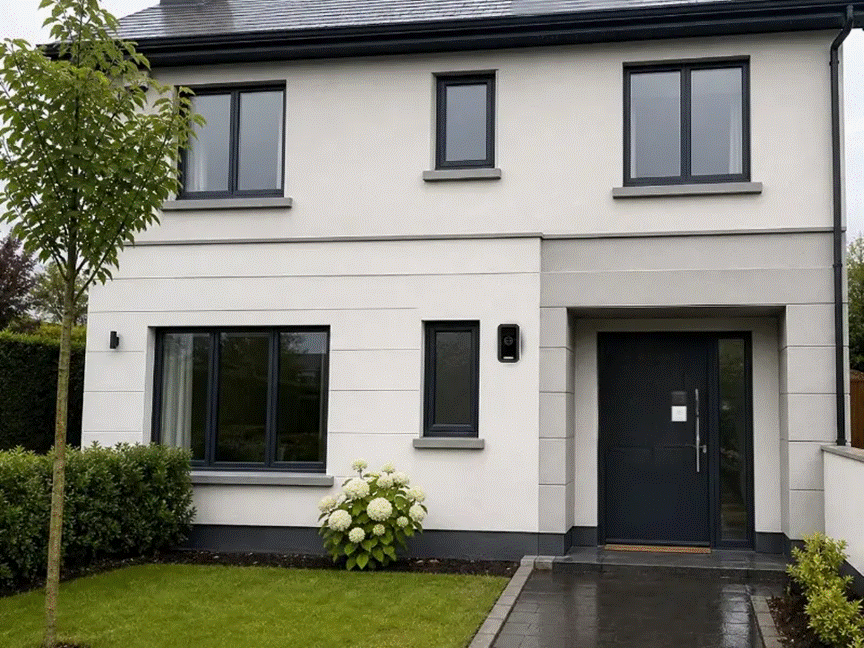
Since 30 April 2024, Airbnb has banned all indoor cameras in listings globally, regardless of location, purpose, or whether they were previously disclosed. There are no exceptions. Outdoor cameras and video doorbells are still permitted, but only if they are disclosed on the advert before the guest books, positioned so they do not monitor indoor spaces, and kept away from high-privacy areas such as garden hot tubs or bedroom windows. Noise-monitoring devices may measure decibel levels only and must not record audio.
Beyond Airbnb's own rules, a host operating camera is a data controller under GDPR. That brings legal duties around lawful basis for processing, transparency and disclosure to guests, data minimisation, and secure storage of any footage. The Data Protection Commission's guidance on CCTV use is the reference point here, and hosts should review it directly.
The approach that keeps hosts compliant and guests comfortable is straightforward: use intrusion sensors indoors for break-in detection rather than cameras and keep cameras to entrances and outdoor areas with clear disclosure. PhoneWatch security cameras connect to the app with consent controls and can be set to record only when the system is armed, with footage held in encrypted cloud storage. That way, cameras work during void periods when no guest is present and switch off when the property is occupied.
Protecting the property between guests
The days between bookings are when a let is most exposed, and not just to intrusion. A burst pipe in an empty property can cause thousands of euros in damage before anyone notices. A smouldering appliance left on by a departing guest can become a fire. These are the risks that turn a hosting side income into a five-figure loss.
A monitored house alarm system designed for this scenario covers more than break-ins. Smoke detection and water-leak sensors catch problems early, and because the system is professionally monitored, an alert at 3 am does not rely on you waking up to check your phone. PhoneWatch also runs daily remote health checks on the system itself, confirming it is alive and communicating even when the property has been empty for days.
Keyholder escalation adds another layer. You nominate a local contact, a neighbour, a cleaner, a property manager, and if an alarm activates while you are hours away, the Alarm Receiving Centre can contact them directly, getting someone to the property quickly. For a host managing a let remotely, this turns a distant worry into a structured, reliable response.
Insurance, registration and running a professional operation
Security is not just about preventing incidents; it is about how you are seen as an operator. A professionally monitored alarm may support an insurance conversation and, on some policies, may qualify you for a discount. This varies by insurer and policy, so check the specific terms with your provider. What is consistent is that a monitored system gives you a clear, time-stamped record of events, which strengthens any claim you might need to make.
On the regulatory side, Ireland is introducing a short-term-let register administered by Fáilte Ireland, currently due to open on 1 December 2026, with hosts required to register by 31 December 2026. The register applies to lets of up to and including 21 nights, and each unit will receive a registration number that must be displayed on all listings and advertisements. It sits alongside and does not replace existing planning and Rent Pressure Zone rules. A principal private residence can generally be let for up to 90 days a year without change-of-use permission. The register aligns with EU Short-Term Rental Regulation (EU) 2024/1028.
Note: the commencement date has already shifted once. Requirements and dates may change, so check Fáilte Ireland and your local authority for your specific situation. This is general guidance, not legal advice.