


Published: August 28, 2026
by
Marguerite Cotter
Whether you run a shop, office, warehouse, or trade premises, security incidents can be costly and disruptive. If you're wondering whether a monitored business alarm is necessary, this guide explains how monitoring works, the risks of going without it, and when the investment makes sense for your business.
Quick Facts: Do I need a monitored alarm for my business in Ireland?
Most Irish businesses benefit from a professionally monitored alarm because, unlike an self-monitored system, monitoring means a certified Alarm Receiving Centre verifies the activation and dispatches a response even when the premises are empty.
-
- A monitored alarm connects to a 24/7 Alarm Receiving Centre (ARC); an unmonitored one only sounds a siren. Element
- PhoneWatch responds to activations in an average of 15 seconds
- Out-of-hours and lone-worker risk is where monitoring adds the most value.
- Retail crime alone costs Irish businesses an estimated €1.62 billion a year (ISME).
- A monitored alarm may be a condition of your business insurance: check your policy.
What is a monitored business alarm, and how is it different?
Before comparing costs or features, it helps to understand the four setups you are really choosing between. Each handles an alarm activation differently, and that difference matters most when your premises are empty.
A bells-only alarm is the most basic option. When triggered, it sounds a siren. There is no notification, no verification and no dispatch. It relies entirely on someone nearby hearing it and deciding to act.A self-monitored system sends app alerts to your phone when something triggers a sensor. You see the alert, you assess it, and you decide what to do. If your phone is on silent, out of battery, or you are simply asleep, the alert goes unanswered.
A professionally monitored alarm connects your system to a certified 24/7 alarm monitoring centre. When an activation comes in, trained operators verify what triggered it using sensor data and camera images, then dispatch the appropriate response. The critical distinction is that verification and response happen whether you are awake, available or anywhere near the premises. PhoneWatch operates the only Irish alarm company's own certified 24/7 Alarm Receiving Centre, built to the EN 50518 standard and handling up to 670,000 activations a year.
When your business is closed, who's watching?
The core weakness of any unmonitored alarm is timing. Most business break-ins do not happen during trading hours when staff are present and neighbours are around. They happen at night, over weekends and on bank holidays, precisely when a bell only alarm has the least chance of being heard by anyone who will act on it.
This is where monitored business alarms differ. Instead of relying on you or a member of staff to manage an alarm activation, a professional Alarm Receiving Centre can assess the alert and take action, helping to protect your premises even when nobody is there.
What Irish business crime data tells us
The scale of business crime in Ireland is well documented, and the figures make a strong case for taking premises security seriously. ISME estimates that retail crime costs Irish businesses approximately €1.62 billion annually. That figure covers stock loss, damage, increased insurance costs and the operational disruption that follows an incident.
According to the Central Statistics Office (CSO), there were 33,180 thefts from shops recorded in 2025, an average of more than 90 every single day. This is up 2% compared to figures from 2024. While Dublin region has seen an increase of 8%, these are not rare events confined to city centres. They affect businesses of every size across the country.
|
Garda Division |
2025 Recorded Incidents |
|
Louth/Cavan/Monaghan Garda Division |
1695 |
|
Donegal Garda Division |
378 |
|
Galway Garda Division |
1379 |
|
Mayo/Roscommon/Longford Garda Division |
699 |
|
Sligo/Leitrim Garda Division |
392 |
|
Cork City Garda Division |
2677 |
|
Cork County Garda Division |
557 |
|
Kerry Garda Division |
674 |
|
Limerick Garda Division |
2001 |
|
Clare/Tipperary Garda Division |
1149 |
|
Kildare/Carlow Garda Division |
1874 |
|
Waterford/Kilkenny Garda Division |
1362 |
|
Laois Offaly Garda Division |
931 |
|
Meath/Westmeath Garda Division |
1398 |
|
Wexford/Wicklow Garda Division |
1341 |
|
D.M.R. South Central Garda Division |
2250 |
|
D.M.R. North Central Garda Division |
3174 |
|
D.M.R. North Garda Division |
2804 |
|
D.M.R. South Garda Division |
2046 |
|
D.M.R. East Garda Division |
1705 |
|
D.M.R. West Garda Division |
2694 |
|
Total |
33,180 |
The extent of organised retail crime prompted An Garda Siochana to launch Operation Tairge in December 2023, a dedicated operation targeting organised theft from retail premises.
What Monitoring Covers and Costs
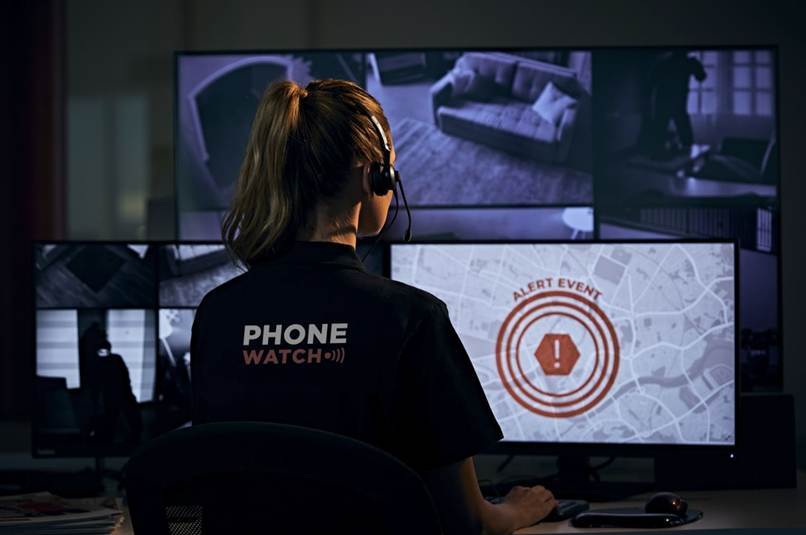
Understanding what actually happens when a monitored alarm activates helps clarify what you are paying for.
When a sensor or detector triggers, the signal reaches the PhoneWatch Alarm Receiving Centre within seconds. Operators verify the activation using a combination of sensor data and camera images. If the activation is genuine, they dispatch the appropriate emergency service, whether that is Gardai, fire or ambulance. If it is a false trigger, they resolve it without an unnecessary callout. This verification step is central to the system's value: it means the right response reaches your premises quickly, and you are not burdened with managing it yourself.
PhoneWatch business alarms come with free installation and a fixed monthly subscription that includes ongoing maintenance, so there are no surprise service charges down the line. Systems are wireless and connect over the mobile network, which means no landline is required. That also eliminates the vulnerability of a phone line being cut. PhoneWatch is PSA licensed (licence number 00621) and systems are certified to the EN 50131 European standard.
For an accurate cost based on your premises, layout and requirements, the most straightforward route is a monitored business alarm system quote, which is free and without obligation.
Is a Monitored alarm Right for your Business?
The answer depends on what you are protecting and when your premises are most vulnerable. Here is a simple way to think about it by premises type.
Retail units combine high footfall, visible stock, cash handling and staff working late or alone. The combination of intrusion detection and a panic button addresses both the property risk and the people risk. Monitoring is strongly worth considering.
Offices may feel lower risk, but they hold IT equipment, sensitive data and are often completely empty overnight and at weekends. A break-in can mean not just theft but significant operational disruption. If your office is unattended for long stretches, monitoring covers the gap.
Trade and warehouse premises often hold high-value stock in locations that are quiet or remote outside working hours. These are exactly the sites where an audible-only alarm achieves the least, because there is simply nobody around to hear it.
If your premises are empty for more hours than they are occupied, and you would not want to be the person driving there alone at 3 am, professional monitoring is doing a job you cannot practically do yourself.
PhoneWatch has spent over 33 years protecting Irish homes and businesses, with more than 120,000 premises on its network and the only dedicated ARC of its kind in Ireland. If you are ready to find out what monitoring would look like for your premises, the next step is straightforward.
Protect Your Business With Monitored Security. Get a system tailored to your premises, backed by a certified 24/7 Alarm Receiving Centre and a 15-second average response. Free installation, a fixed monthly subscription including maintenance, and no landline needed.